Good offshore healthcare is built on more than clinical skills alone.
It relies on experienced people, clear governance and access to the right support at the right time.
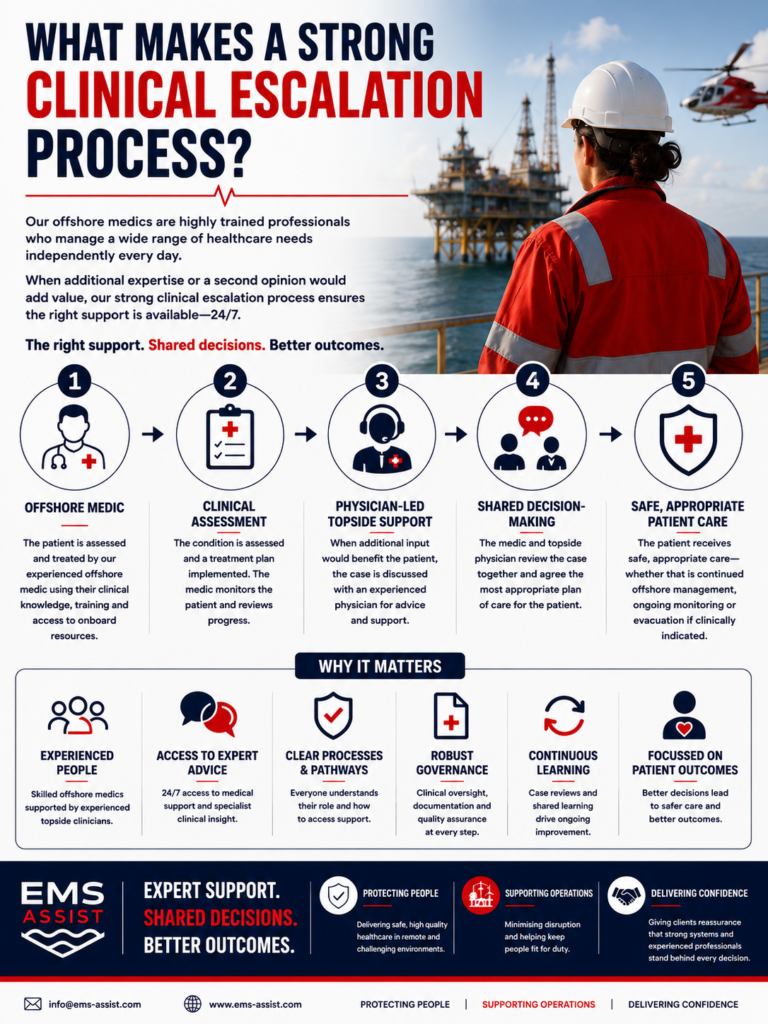
Offshore medics are highly trained professionals who manage a wide range of healthcare needs independently every day—from minor injuries and illness to health promotion, occupational health activities and emergency response.
They make important clinical decisions in remote and often challenging environments, balancing the needs of the individual with the realities of working offshore.
But, just like healthcare professionals in any other setting, there are occasions when additional clinical expertise, specialist advice or senior medical oversight is required.
That’s where a strong clinical escalation process becomes invaluable.
Supporting Good Clinical Decision-Making
Clinical escalation is not about taking decisions away from offshore medics.
It’s about ensuring clinicians have access to the professional support and clinical discussion they need to make safe, informed decisions.
Depending on the circumstances, clinical escalation may help to:
- Confirm or review a diagnosis and treatment plan
- Discuss fitness to remain offshore
- Review medication or treatment options
- Support decisions around monitoring and follow-up
- Consider whether further assessment or evacuation may be required
- Provide additional expertise when managing an unfamiliar or evolving presentation
Most importantly, it helps ensure decisions remain patient-centred, evidence-based and consistent.
Knowing When to Escalate
A strong escalation process should make it clear when additional clinical input is required and how that support can be accessed.
In some clinical situations, escalation is not optional.
Defined protocols should identify circumstances where physician input is required, helping ensure higher-risk presentations and significant clinical decisions receive appropriate senior medical oversight.
There should also be a culture where clinicians feel comfortable seeking advice whenever they believe additional input would benefit the patient.
Good escalation isn’t a sign of uncertainty or weakness.
Knowing when to seek additional expertise is part of good clinical practice.
Offshore Doesn’t Mean Working Alone
Remote environments create unique clinical challenges.
Access to experienced topside medical support means offshore clinicians have additional expertise available when it is required.
Whether reviewing an evolving presentation, discussing treatment options or supporting a complex clinical decision, access to an experienced physician provides another layer of clinical support.
It reinforces good practice.
It encourages shared decision-making.
And it helps deliver safe, consistent care across the workforce.
Clinical Governance Matters
Strong clinical escalation is only one part of a wider clinical governance framework.
It should sit alongside:
- Clear clinical protocols and procedures
- Regular professional development
- Robust clinical documentation
- Effective handovers
- Case review and shared learning
- Clinical audit and quality improvement
- Ongoing Medical Director oversight
Together, these systems help ensure that clinical care is not dependent on one individual working in isolation.
Instead, clinicians operate within a structured system designed to support safe, effective and consistently high standards of patient care.
Learning From Every Case
A strong escalation process shouldn’t end when the immediate clinical issue has been resolved.
Clinical documentation, case review and shared learning provide opportunities to understand what went well, identify areas for improvement and strengthen future practice.
Over time, this creates a cycle of continual improvement where individual cases contribute to stronger clinical systems across the wider organisation.
Confidence Through Collaboration
The best offshore medical services are not defined by one person.
They are built around experienced clinicians, clear escalation pathways, strong governance and a culture where collaboration is valued.
At EMS Assist, our offshore medical personnel are supported by physician-led topside medical support and a structured clinical governance framework, helping ensure appropriate expertise is available when it is needed.
For our medics, that means knowing they have experienced clinical professionals behind them.
For our clients, it provides reassurance that clinical decisions are supported by robust systems, clear processes and appropriate medical oversight.
And for the patient, it means the focus remains where it should always be:
Safe, appropriate and high-quality care.
Because great healthcare isn’t simply about individual expertise.
It’s about creating an environment where clinicians are supported to make the right decisions for their patients.
Supporting Your Offshore Workforce
EMS Assist provides integrated offshore medical services supported by 24/7 physician-led topside support, clinical governance, occupational health and emergency preparedness solutions.
If you’d like to discuss how we can support the clinical governance and medical requirements of your offshore operations, we’d be pleased to help.
📧 info@ems-assist.com
🌐 www.ems-assist.com
Protecting People | Supporting Operations | Delivering Confidence