When people think about serious workplace injuries, they often picture major accidents.
But some of the most significant and potentially life-changing injuries can involve something we rely on every single day:
Our hands.
From cuts and lacerations to fractures, crush injuries and, in the most serious cases, amputations, hand and finger injuries can have consequences that extend far beyond the workplace.
And while an injury may sometimes appear relatively minor at first, the impact can be significant and long-lasting.
Small Injuries Can Have Lasting Consequences
Our hands are involved in almost everything we do.
Working.
Driving.
Cooking.
Playing with our children.
Buttoning a shirt.
Holding a cup of coffee.
Even a relatively small hand injury can affect everyday activities, both at work and at home.
More serious injuries may require surgery, lengthy rehabilitation or extended periods away from work and can have a lasting impact on an individual’s independence and quality of life.
That’s why hand safety should never be treated as an afterthought.
Many Hand Injuries Are Preventable
The encouraging thing is that many hand and finger injuries can be prevented through simple but effective precautions.
Before beginning a task, take a moment to consider:
- Are there any pinch points?
- Are there moving or rotating parts?
- Are there sharp edges?
- Are chemicals involved?
- Are there hot surfaces?
- Is the correct PPE being worn?
- Am I using the right tool for the job?
- Can the task be carried out without placing my hands in the line of fire?
Taking a few moments to identify the hazards and consider where your hands could be exposed can make a significant difference.
Think About Where Your Hands Are
One of the simplest—but most important—ways to reduce the risk of injury is to remain conscious of hand placement.
Hand injuries can occur when hands are:
- Placed between moving and fixed objects
- Positioned close to pinch points
- Hidden or obscured from view
- Exposed to sharp edges
- Too close to moving or unguarded equipment
A pinch point is an area where part of the body could become trapped between moving parts, or between a moving object and a stationary one.
These hazards can be present in many routine offshore and industrial tasks.
Familiarity should never replace awareness.
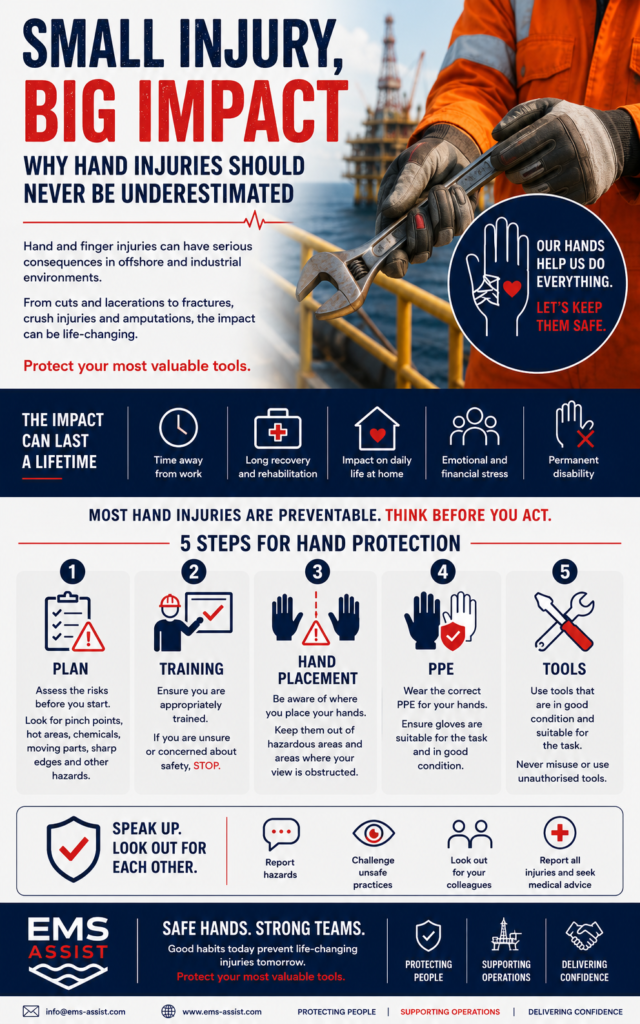
Five Simple Steps to Protect Your Hands
Good hand safety starts with good habits.
- Plan
Assess the task before you begin. Identify pinch points, moving equipment, sharp edges, hot surfaces and other potential hazards.
- Training
Make sure you are appropriately trained and understand how the task should be completed safely. If you’re unsure, stop and ask.
- Hand Placement
Think about where your hands are throughout the task. Keep them away from hazardous areas and never place them somewhere you cannot clearly see.
- PPE
Wear the appropriate hand protection for the task and ensure it is suitable and in good condition.
- Tools
Use the correct tool for the job. Equipment should be suitable, maintained and used as intended.
Simple steps—but steps that can help prevent life-changing injuries.
Speak Up. Look Out for Each Other.
Hand safety isn’t only an individual responsibility.
If you identify a hazard, report it.
If you see an unsafe practice, speak up.
If a colleague is placing themselves at risk, look out for them.
And if an injury does occur, no matter how minor it initially appears, report it and seek appropriate medical assessment.
A strong safety culture is one where people feel comfortable raising concerns and where everyone takes responsibility for protecting themselves and those around them.
Protect Your Most Valuable Tools
The best safety measures are often the simplest.
Stay alert.
Follow procedures.
Use the correct equipment.
Report hazards.
Look out for one another.
And never underestimate the importance of protecting your hands.
At EMS Assist, we believe preventing injuries is just as important as treating them.
Through experienced medical personnel, health promotion, workforce education and proactive health and safety support, we help organisations create safer, healthier and more resilient workplaces.
Because sometimes the smallest injuries can have the biggest impact.
Supporting Safer Workforces
If you’re looking to strengthen workforce health, medical support or health promotion across your offshore or remote operations, we’d be pleased to discuss how EMS Assist can support your project.
📧 info@ems-assist.com
🌐 www.ems-assist.com
Safe Hands. Strong Teams.
Protecting People | Supporting Operations | Delivering Confidence