When a medical emergency occurs offshore, decisions often need to be made in minutes.
Who should be contacted first?
Can the patient be treated safely on board?
Is medical evacuation required?
Where should the patient be transferred, and how will they get there?
During an emergency, there is little time to work through these questions for the first time. That’s why the planning needs to happen long before the project begins.
A well-developed Medical Emergency Response Plan (MERP) provides the framework that allows everyone involved — from offshore personnel and vessel management to medics and onshore support teams — to respond confidently, consistently and efficiently when it matters most.
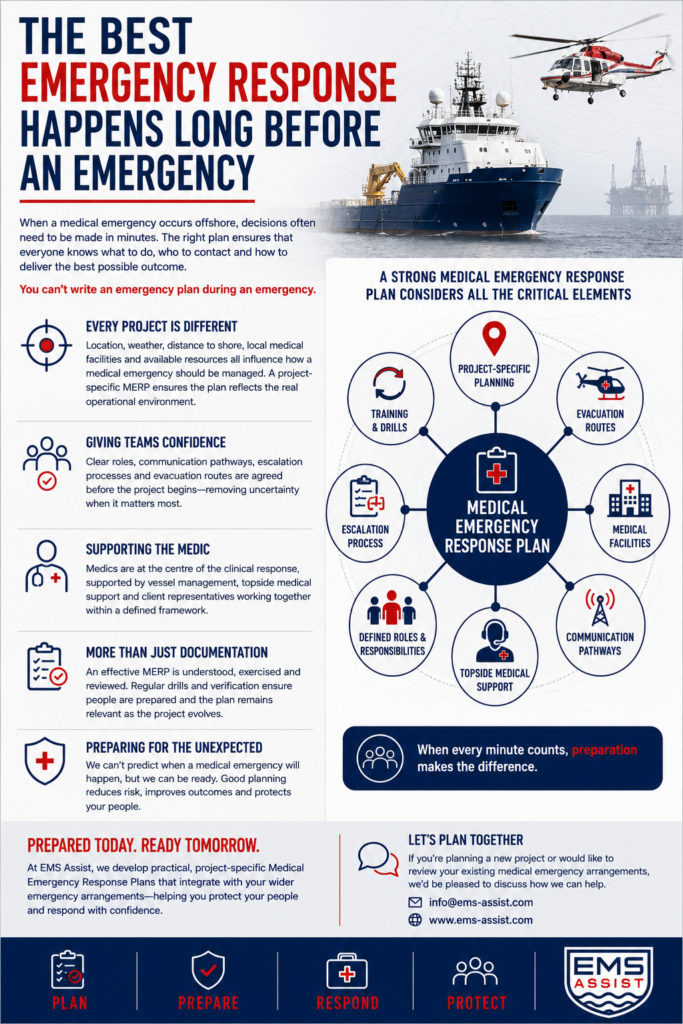
Every Project Is Different
No two offshore projects are the same.
The location, vessel type, available medical facilities, evacuation options, weather conditions and local emergency services can all influence how a medical emergency should be managed.
A response plan that works for one project may not be appropriate for another.
That’s why effective Medical Emergency Response Plans are developed specifically for each project, ensuring that medical support arrangements reflect the operational environment and the resources available.
Effective planning must also consider what happens when the preferred response isn’t possible.
Weather restrictions, changes in vessel location, helicopter availability or delays in evacuation can all affect the options available. Identifying alternative arrangements in advance helps teams respond more effectively when circumstances change.
Giving Teams Confidence Before an Incident Occurs
One of the greatest strengths of a Medical Emergency Response Plan is that it helps remove uncertainty.
Everyone understands their role.
Communication pathways are clearly defined.
Escalation processes have already been agreed.
Medical evacuation options and contingencies have been considered.
Appropriate receiving hospitals and medical facilities have been identified, along with arrangements for confirming their suitability and availability when needed.
This allows those involved in the response to focus on the patient, rather than trying to make complex logistical decisions for the first time during a high-pressure situation.
Supporting the Medic
An offshore medic is at the centre of the clinical response, but they should never be expected to manage a complex emergency in isolation.
A well-designed MERP provides the operational framework that supports the wider response and enables timely clinical decision-making.
It clearly defines how the medic works alongside the vessel management team, topside medical support, client representatives and emergency services, ensuring everyone understands their responsibilities and how information flows throughout the incident.
When the framework is already in place, the medic can focus on delivering the best possible care while knowing that the wider response is being coordinated effectively.
Planning Is More Than Documentation
An effective MERP is far more than a document sitting on a shelf.
It should be understood by those who may need to use it, tested through realistic exercises and reviewed as projects evolve.
Drills provide an opportunity to check whether communication pathways work, responsibilities are understood and evacuation arrangements are practical.
They can also reveal gaps or assumptions that may not be apparent when reviewing the plan on paper.
As project locations, personnel, resources and operating conditions change, the MERP should be reviewed to ensure it remains relevant.
A plan is only effective if the people responsible for implementing it know what to do.
Preparing for the Unexpected
No organisation wants to experience a medical emergency offshore. However, being prepared is an essential part of protecting people working in remote and challenging environments.
Good emergency planning brings together clinical expertise, operational knowledge, clear communication and practical arrangements for managing an incident.
At EMS Assist, we work closely with our clients to develop practical, project-specific Medical Emergency Response Plans that integrate with their wider emergency response arrangements.
By considering the realities of each operation, defining responsibilities and identifying appropriate medical support and evacuation options, we help organisations prepare for situations where timely, coordinated action is essential.
If you’re planning a new offshore project or would like to review your existing medical emergency arrangements, we’d be pleased to discuss how we can help.
Email: info@ems-assist.com
Website: www.ems-assist.com
Because the best emergency response doesn’t begin when the alarm is raised.
It begins long before the emergency happens.
Protecting People | Supporting Operations | Delivering Confidence