When we think about offshore safety, we often think about hazards we can see.
Heavy lifting. Working at height. Moving equipment. Challenging weather conditions.
But some risks are much harder to see.
Fatigue is one of them.
It can develop gradually, sometimes without the individual or those around them immediately recognising how much their performance has been affected.
In a safety-critical offshore environment, that matters.
Fatigue Is More Than Feeling Tired
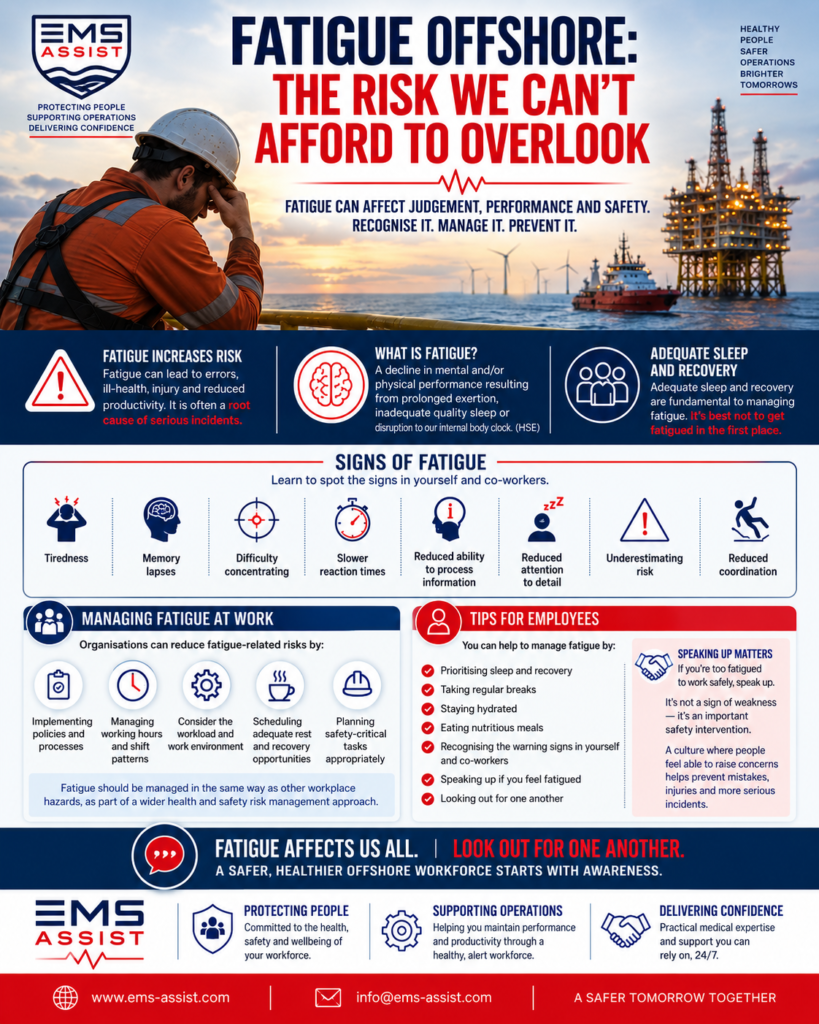
The Health and Safety Executive (HSE) defines fatigue as a decline in mental and/or physical performance resulting from prolonged exertion, inadequate quality sleep or disruption to the body’s internal clock.
Fatigue can affect:
- Concentration and vigilance
- Memory
- Reaction times
- Decision-making
- Awareness
- Coordination
- Ability to process information
- Perception of risk
HSE guidance highlights that sleep deprivation and fatigue can particularly affect tasks requiring vigilance, decision-making, awareness, fast reaction times and memory.
In an office environment, a lapse in concentration might mean correcting a mistake.
Offshore, where people may be working with heavy equipment, at height or in other safety-critical roles, the consequences can potentially be much more serious.
Why Fatigue Is an Offshore Challenge
Offshore working can create a combination of factors that influence fatigue.
Long shifts, consecutive working days, night work, travel, disrupted sleep patterns and time away from normal routines can all affect rest and recovery.
The work itself can also contribute. HSE notes that tasks requiring constant attention, or work that is complex, monotonous or machine-paced, can increase the risk of fatigue.
This is why fatigue shouldn’t simply be viewed as an individual feeling tired.
It is a human-factors issue that can affect safety, health and operational performance.
HSE guidance on human factors specifically identifies fatigue and shift work as influences on performance that organisations need to actively manage as part of controlling health and safety risks.
Recognising the Warning Signs
Fatigue doesn’t always announce itself.
Warning signs may include:
- Persistent tiredness or sleepiness
- Difficulty concentrating
- Memory lapses
- Slower reactions
- Reduced attention to detail
- Difficulty processing information
- Reduced coordination
- Poorer judgement or awareness
Sometimes the person experiencing fatigue may not fully appreciate how much their performance has changed.
That makes awareness across the wider team important too.
Recognising the signs in ourselves and in colleagues can provide an opportunity to act before fatigue contributes to an incident.
Managing Fatigue Requires a Team Approach
Managing fatigue shouldn’t rely solely on individuals being told to get more sleep.
Organisations can reduce fatigue-related risk by considering factors such as working hours, shift patterns, workload, rest and recovery opportunities and the demands of safety-critical tasks.
Poorly designed shift schedules and long working hours can contribute to chronic fatigue where there is insufficient time for rest and recovery.
Workers also have an important part to play.
Prioritising sleep and recovery, staying hydrated, taking appropriate breaks, recognising personal warning signs and reporting concerns can all support safer working.
But effective fatigue management requires the working environment and the individual to work together.
Speaking Up Matters
Most people wouldn’t hesitate to report a physical injury that could affect their ability to work safely.
Fatigue should be treated with the same seriousness.
Someone saying:
“I’m too fatigued to do this safely.”
shouldn’t be regarded as a lack of resilience.
It can be an important safety intervention.
Creating an environment where people feel able to raise concerns about fatigue — whether in themselves or a colleague — can help identify risks before they contribute to mistakes or incidents.
From Awareness to Prevention
Fatigue awareness is important, but awareness alone isn’t enough.
The bigger question is whether fatigue has been considered within the way work is planned and managed.
That can mean asking:
Are working patterns allowing adequate recovery?
Could travel or shift changes contribute to fatigue?
Are safety-critical tasks being undertaken during periods of reduced alertness?
Do workers know how to recognise the warning signs?
And do they feel able to speak up when something isn’t right?
These are practical questions that can help turn fatigue awareness into meaningful risk management.
A Risk We Can’t Afford to Overlook
Fatigue may be difficult to see.
Its effects are not.
It can influence judgement, concentration, reaction time, health and ultimately the safety of the people working around us.
At EMS Assist, we believe protecting offshore workforces means looking beyond the most visible hazards and considering the human factors that can influence health, safety and performance.
Through offshore medical support, occupational health, health promotion and workforce wellbeing initiatives, we work with organisations to help protect their people and support safer operations.
Because protecting people starts with recognising the risks we can’t always see.
📧 info@ems-assist.com
🌐 www.ems-assist.com
Protecting People | Supporting Operations | Delivering Confidence