First aid is a vital part of any effective emergency response plan.
Trained first aiders can provide immediate care and play a critical role during the early stages of a medical emergency.
But in offshore and remote environments, there is another important question to consider:
Is first aid provision alone appropriate for the risks of the project?
There isn’t one answer that applies to every project.
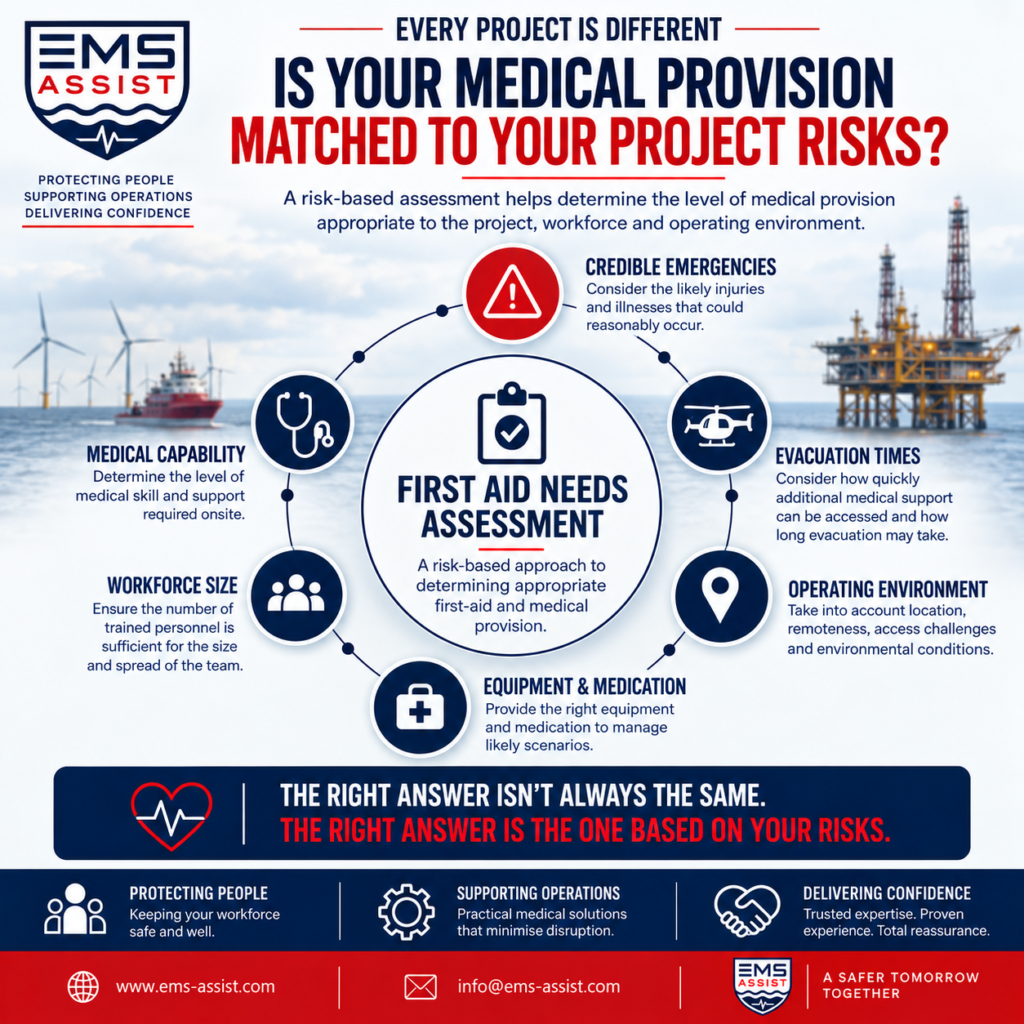
The appropriate level of medical provision depends on the hazards involved, the working environment, the size and location of the workforce, foreseeable medical emergencies and how quickly additional medical care can be accessed.
That’s why planning needs to begin with the risks.
Start With the First Aid Needs Assessment
Every project is different.
A small team carrying out relatively low-risk activities may have very different requirements from a large offshore construction campaign involving complex operations, multiple work locations and potentially lengthy evacuation times.
HSE’s Principles for Provision of First Aid for the Wind Industry states that duty holders should take a risk-based approach to their First Aid Needs Assessment (FNA), considering foreseeable emergencies and the likely hazards to which a work party may be exposed.
Importantly, the assessment should consider illness as well as injury.
The FNA should also consider whether there are sufficient trained personnel available to respond and identify the medication and equipment required to enable immediate lifesaving intervention.
The objective isn’t to apply the same medical arrangement to every project.
It’s to make sure the provision reflects the actual risks and operating environment.
What Happens When Help Is Further Away?
For offshore and remote projects, access to additional medical care can be a significant consideration.
HSE states that the FNA should consider how long it could take to access additional medical support.
Where evacuation could be delayed, duty holders should consider whether the first-aid capability available is sufficient to maintain a casualty over a prolonged period.
Depending on the assessment, this may necessitate additional medical capability, including a person with a qualification equivalent to an offshore medic.
HSE also identifies circumstances where access to an emergency doctor service may need to be considered when emergency services could be delayed — including support equivalent to a topside doctor.
This doesn’t mean every project requires an offshore medic or topside support.
It means the level of medical provision should be determined by the risks.
Plan for the Credible Emergency
A serious medical incident may never happen.
But effective emergency planning isn’t based solely on what happens most often.
It should also consider what could reasonably happen — and whether the project is prepared to respond if it does.
What injuries and illnesses are foreseeable?
How quickly can a casualty be reached?
What treatment can be provided at the worksite?
How long could evacuation take?
And what happens if additional clinical expertise is required before the casualty reaches further medical care?
These are the questions that help determine whether the medical provision is appropriate for the project.
Medical Support Beyond the Emergency
Where an offshore medic forms part of that provision, their role can extend beyond emergency response.
Day-to-day illness and injury, workforce health, medical advice and health promotion can all form part of the wider medical support available onsite.
Combined with physician-led topside support where appropriate, this can provide access to additional clinical expertise when a situation requires it.
The result is a medical arrangement designed around the realities of the project — rather than a one-size-fits-all approach.
The Right Answer Isn’t Always the Same
For some projects, appropriately trained first aiders and suitable equipment may provide the level of capability identified by the assessment.
For others, remoteness, project hazards, workforce size, evacuation times or foreseeable medical scenarios may indicate a need for additional medical support.
The important question isn’t simply:
“Do we have first aid cover?”
It’s:
“Does our medical provision match the risks of this project?”
At EMS Assist, we believe medical planning should be risk-based, proportionate and practical.
We work with clients to understand the realities of their projects and develop appropriate medical arrangements — whether that involves supporting existing first-aid provision, providing experienced offshore medical personnel, physician-led topside support, medical equipment and pharmaceuticals, or supporting medical emergency response planning.
Because the right answer isn’t always the same.
The right answer is the one based on your risks.
If you’d like to discuss the medical requirements of an upcoming project, we’d be pleased to help.
📧 info@ems-assist.com
🌐 ems-assist.com
Protecting People | Supporting Operations | Delivering Confidence