Every organisation has health and safety procedures. Every project has rules. Every worksite has risk assessments, toolbox talks and permit systems.
These provide the framework for safe operations.
But what happens when nobody is watching?
The strongest safety cultures are those where people make safe decisions because those behaviours have become part of the way they work — not simply because a procedure tells them to.
They stop and think. They challenge something that doesn’t look right. They look out for colleagues. They make the safer choice even when it might not be the easiest one.
Developing that kind of environment requires more than compliance.
It requires influence.
Safety Is Influenced Every Day
Behaviour is shaped by what people see and experience around them.
We observe how colleagues approach their work, how supervisors respond when concerns are raised and how leaders react when something doesn’t go to plan.
If shortcuts are routinely accepted, they can quickly become normalised.
If concerns are dismissed, people may become less willing to speak up.
But when safe behaviours are consistently demonstrated, encouraged and recognised, they can influence the expectations of the wider team.
Culture is built through these everyday interactions.
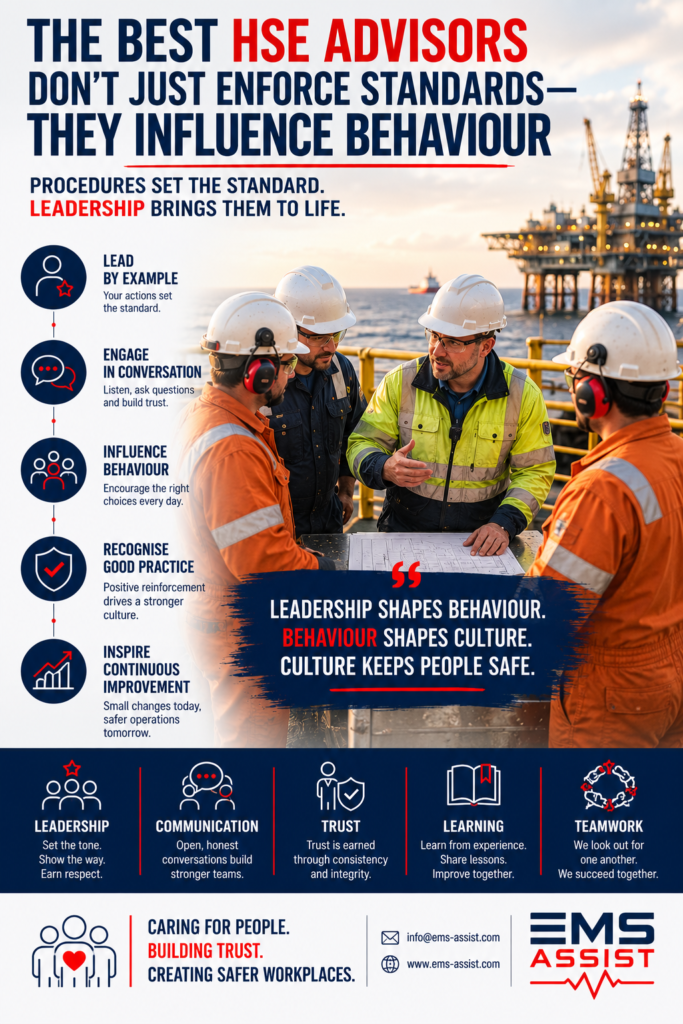
That is why leadership at every level matters — and why an experienced HSE Advisor can have an impact far beyond procedures and paperwork.
Leading by Example
The most effective HSE Advisors don’t rely on authority alone.
They build influence through visibility, consistency and trust.
They ask questions.
They listen.
They coach rather than simply criticise.
They recognise good practice as well as identifying opportunities for improvement.
And importantly, they lead by example.
Whether participating in toolbox talks, walking the worksite, supporting risk assessments, reviewing work activities or engaging directly with the workforce, their actions reinforce the standards and behaviours they want to see across the project.
People are far more likely to engage with safety when they understand its purpose and feel part of the conversation.
Conversations That Can Change Behaviour
Some of the most valuable safety interventions don’t happen during formal audits or investigations.
They happen during conversations.
A discussion before a task begins.
A question that encourages someone to think differently about a risk.
A positive challenge when something doesn’t feel right.
A supervisor taking the time to listen to a concern.
Or an HSE Advisor explaining why a particular control measure matters rather than simply saying that it must be followed.
These interactions help create understanding rather than compliance alone.
Over time, they can influence how people approach risk long after the conversation has ended.
Creating Ownership
Great HSE Advisors don’t try to own safety. They help everyone else own it.
Their role isn’t to become the person responsible for every safe decision on a project.
Instead, they support supervisors, managers and the wider workforce in recognising their own role in creating a safe working environment.
That can mean encouraging participation in toolbox talks, supporting effective planning, promoting hazard and near-miss reporting, recognising positive behaviours and creating an environment where people feel confident to ask questions or raise concerns.
When people are genuinely engaged in the safety process, something important changes.
They are no longer simply following instructions.
They become active participants in creating safer ways of working.
Recognising What Goes Right
Good safety leadership isn’t only about identifying what is wrong.
Recognising positive behaviours matters too.
When someone stops a task because conditions have changed, raises a concern, identifies a hazard or suggests a safer way of completing the work, those behaviours should be encouraged.
Positive reinforcement helps demonstrate what good practice looks like and sends an important message to the wider workforce:
Speaking up is valued.
Learning from what goes well can be just as valuable as learning from what goes wrong.
Continuous Improvement Through Learning
No project, procedure or system should remain static.
Operations change. Risks evolve. Teams gain experience.
Strong HSE cultures create opportunities to capture that experience and use it to improve.
Near misses, observations, incident investigations, workforce feedback and everyday conversations can all provide valuable lessons.
An effective HSE Advisor helps turn those lessons into practical improvements — sharing knowledge, challenging assumptions and helping teams consider how work can be carried out more safely next time.
The objective isn’t perfection.
It’s continual learning and improvement.
From Compliance to Culture
Health and safety is about more than meeting standards.
It is about creating an environment where people understand those standards, believe in their purpose and feel confident contributing to safer ways of working.
At EMS Assist, we believe effective HSE Advisors combine technical expertise with strong leadership, positive communication and the ability to influence behaviour through example.
Our HSE professionals work alongside operational teams, supporting risk management, encouraging workforce engagement and helping organisations strengthen health, safety and environmental performance across offshore and remote projects.
Standards provide the framework. People bring them to life.
If you’d like to learn more about EMS Assist’s HSE Advisory services, we’d love to hear from you.
📧 info@ems-assist.com
🌐 www.ems-assist.com
Leadership influences behaviour. Behaviour shapes culture. Culture keeps people safe.